Introduction
Are you preparing for the AMC CAT 2026 but your mock-test scores are not improving as quickly as you expected?
You may be studying for several hours every day, completing hundreds of MCQs and reviewing medical topics, yet still finding that your scores remain inconsistent.
The problem may not be the amount of time you study. It may be how you are preparing.
The AMC CAT MCQ examination is a computer-administered examination consisting of 150 multiple-choice questions in one 3.5-hour session, with one correct response from five options. The examination assesses essential medical knowledge including disease processes, clinical examination and diagnosis, investigation, therapy and management. (AMC)
For 2026, the Australian Medical Council has also introduced a slight increase in the MCQ pass standard, while keeping the reported score scale at 0–500 and the pass mark described as 250. (AMC)
That makes an efficient preparation strategy even more important.
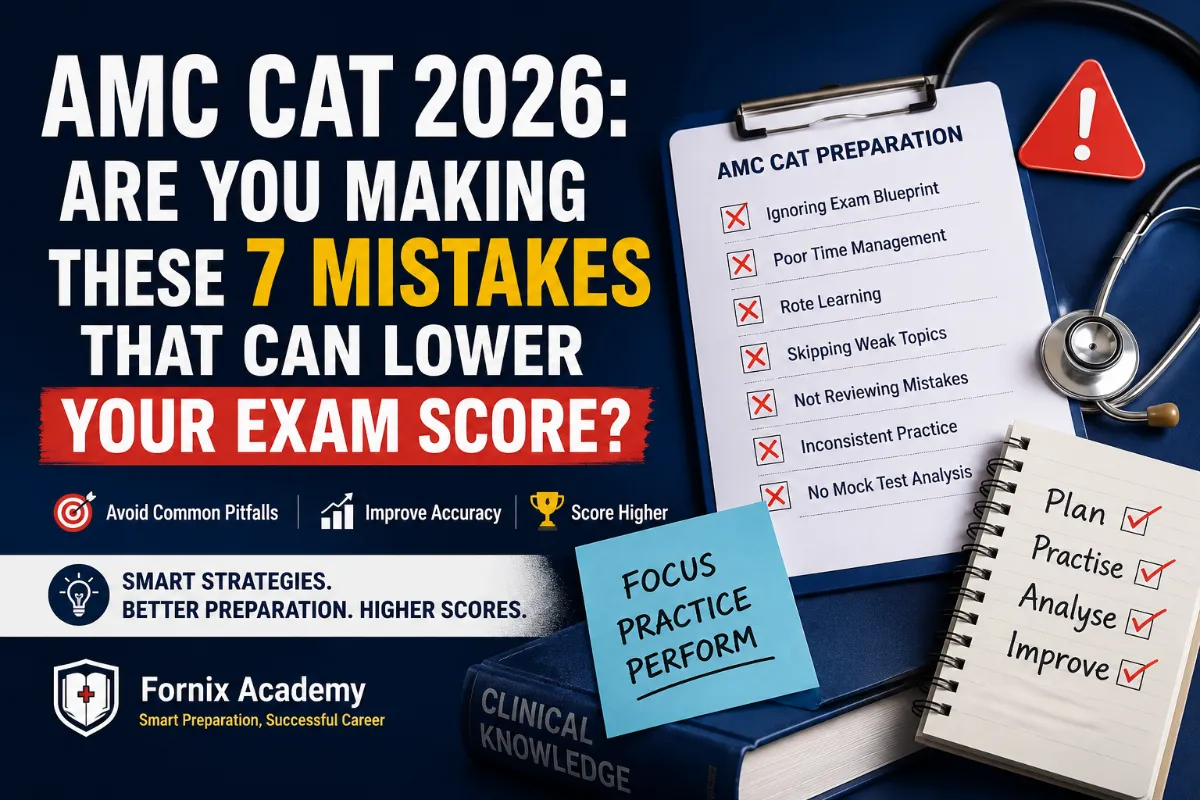
Here are 7 common AMC CAT preparation mistakes that may be holding your score back.
1. Solving MCQs Without Reviewing Your Mistakes
One of the biggest mistakes candidates make is treating MCQs as a numbers game.
For example, you might complete:
- 100 questions today
- 150 questions tomorrow
- 200 questions the next day
But if you simply check the correct answer and move on, you are missing the most valuable part of question practice: learning from your mistakes.
After every practice session, ask:
- Why did I choose the wrong answer?
- Did I misunderstand the clinical presentation?
- Did I miss an important clue?
- Did I choose the wrong investigation?
- Did I confuse two similar conditions?
- Did I know the answer but make a careless mistake?
Your incorrect answers should become a personal revision database.
The goal isn't simply to answer more questions.
The goal is to reduce the number of mistakes you make in your next test.
2. Memorising Answers Instead of Understanding Clinical Reasoning
AMC CAT preparation should not become an exercise in memorising question-bank answers.
The AMC describes its MCQ content around clinical knowledge and application, including diagnosis, investigation, therapy and management. (AMC)
That means you should ask yourself:
“Why is this the best answer?”
rather than:
“Have I seen this question before?”
For every important clinical question, try to identify:
Presentation → Key clue → Differential diagnosis → Investigation → Diagnosis → Management
This approach helps you deal with unfamiliar questions instead of relying on memory.
3. Studying Too Many Resources at the Same Time
Another common problem is resource overload.
You start with one textbook.
Then you download another PDF.
Then you join another Telegram group.
Then you purchase another question bank.
Then you watch multiple YouTube lectures.
Eventually, you have plenty of resources but no structured revision system.
The AMC itself recommends that candidates understand the examination specifications and use its MCQ preparation resources. (AMC)
Instead of constantly adding resources, choose a core preparation system and stay consistent with it.
A simple structure can be:
Core concepts → MCQs → Mistake review → Revision → Mock test → Performance analysis
4. Ignoring Clinical Context
IMGs preparing for the AMC CAT may sometimes focus heavily on textbook facts while neglecting clinical application.
The AMC notes that its MCQ examination assesses medical knowledge and practice, and recommends reviewing major clinical topics and becoming familiar with the MCQ format. (AMC)
When solving questions, pay attention to:
- Patient age
- Symptoms and duration
- Risk factors
- Examination findings
- Vital signs
- Investigation results
- Red flags
- Most likely diagnosis
- Most appropriate next step
A single sentence in a clinical vignette can completely change the answer.
Don't read AMC questions like simple recall questions. Read them like clinical problems.
5. Not Analysing Your Mock-Test Performance
Taking mock tests is useful.
But taking mock tests without analysing them is much less useful.
Suppose your mock score is 58%.
Don't simply say:
“I need to study more.”
Instead, break the result down.
For example:
| Problem | What to investigate |
|---|---|
| Wrong answers | Knowledge gap or reasoning error? |
| Unanswered questions | Time-management problem? |
| Changed answers | Lack of confidence? |
| Repeated mistakes | Weak topic? |
| Careless errors | Concentration issue? |
Your mock test should tell you what to study next.
The AMC's official preparation guidance recommends familiarising yourself with the examination format and using preparation resources. (AMC)
6. Practising Without a Time Strategy
The AMC CAT MCQ examination is completed in a 3.5-hour session, with 150 questions. (AMC)
That means preparation should include timed practice.
You should gradually become comfortable with:
- Reading clinical stems efficiently
- Identifying key information
- Eliminating incorrect options
- Making a decision
- Moving forward without unnecessarily spending too much time on one question
During practice, don't always solve questions in a relaxed environment.
Include timed blocks in your preparation.
This helps develop both knowledge and exam stamina.
7. Changing Your Preparation Strategy Too Often
Perhaps the most damaging mistake is constantly changing your strategy.
One week you decide to study textbooks.
The next week you focus only on MCQs.
Then you switch to videos.
Then you start another question bank.
Then you completely change your study timetable.
Consistency matters.
A better approach is to build a preparation cycle:
Learn
Study the clinical concept.
Practise
Solve relevant MCQs.
Analyse
Understand every incorrect answer.
Revise
Review weak areas and recurring mistakes.
Test
Take a timed mock examination.
Improve
Use your performance data to decide what to study next.
Repeat this cycle consistently.
How to Improve Your AMC CAT Preparation
Instead of asking:
“How many hours should I study?”
ask:
“How effectively am I using my study hours?”
A productive AMC CAT preparation routine can include:
Daily
- Clinical concept revision
- Focused MCQ practice
- Review of incorrect answers
- Short revision of weak topics
Weekly
- Timed MCQ blocks
- Performance analysis
- Revision of recurring mistakes
- Identification of weak clinical areas
Regularly
- Full-length mock tests
- Detailed mock analysis
- Revision of high-yield concepts
- Adjustment of your study strategy
The AMC also provides a free MCQ preparation app with 210 practice questions and feedback, available to candidates who have purchased AMC MCQ authorisation. (AMC)
Use official resources as part of your preparation, but don't rely on simply completing questions. Understanding why an answer is correct is where much of the learning happens.
Final Takeaway
Your AMC CAT score may not improve simply because you solve more questions.
It improves when you learn from your mistakes, strengthen clinical reasoning, practise under time pressure and systematically revise your weak areas.
If you are making any of these seven mistakes, don't panic.
Identify the problem, change your approach and track your progress.
Remember:
More MCQs ≠ Better preparation.
Better analysis + better clinical reasoning + consistent revision = Better preparation.
Start by reviewing your last three mock tests and identifying your top three recurring mistakes.
That may be more valuable than simply starting another 100 questions today.
Frequently Asked Questions
How many questions are in the AMC CAT MCQ examination?
The AMC CAT MCQ examination consists of 150 multiple-choice questions, with one correct response from five options. (AMC)
How long is the AMC CAT MCQ examination?
The examination is conducted in one 3.5-hour session. (AMC)
Has the AMC CAT pass standard changed in 2026?
Yes. The AMC introduced a slight increase in the MCQ pass standard from 2026. Results continue to be reported on a 0–500 scale, with the pass mark described as 250. (AMC)
Does the AMC CAT examination have negative marking?
The AMC's published examination specifications state that marks are not deducted for incorrect answers. (AMC)
Does solving more AMC CAT MCQs guarantee a higher score?
No. Question volume alone does not guarantee improvement. Candidates should analyse incorrect answers, identify knowledge gaps and develop clinical reasoning and time-management skills.
What is the best way to use AMC CAT mock tests?
Don't focus only on your final score. Analyse incorrect answers, repeated mistakes, weak clinical areas, time-management problems and questions where you changed a correct answer.
Prepare Smarter with Fornix Academy
Preparing for AMC CAT requires more than simply reading textbooks.
You need high-quality MCQs, clinical explanations, mock exams, performance analysis and consistent revision.
Fornix Academy is designed to help medical graduates practise clinical questions, identify weak areas and build a structured AMC CAT preparation routine.
Study smarter. Practise consistently. Analyse every mistake.
Written by: Venkat
Fornix Academy
Contact
🌐 Website: www.fornixacademy.com
📞 Call: +91 90304 48482
📧 Email: venkat@fornixacademy.com
📱 Instagram: @fornix.academy