Introduction
Completing an MBBS or equivalent medical degree abroad is increasingly common among Indian students. Graduates may return to India and attempt the Foreign Medical Graduate Examination (FMGE), but not every candidate clears it on the first attempt.
If you have failed FMGE, does that mean your medical career is over? No. However, the correct answer is more nuanced: FMGE is connected to medical registration in India, while other countries have their own medical regulators and licensing systems.
This means a foreign medical graduate may be able to explore another country's medical registration pathway, but must satisfy that country's rules before practising medicine legally.
The safest way to think about the situation is: foreign medical degree → choose a country → verify the qualification → complete that country's registration/licensing requirements → obtain a licence → practise legally.
What Happens If You Fail FMGE?
FMGE is India's screening examination for eligible Indian citizens and Overseas Citizens of India who hold primary medical qualifications from foreign medical institutions and seek registration in India. The National Medical Commission publishes the relevant screening-test framework and guidance for foreign medical graduates.
NMC – Screening Test Regulations / FMG information
Therefore, failing FMGE can prevent the graduate from obtaining Indian medical registration through the applicable FMGE route. It does not, by itself, determine whether another country's regulator will accept the person's medical qualification.
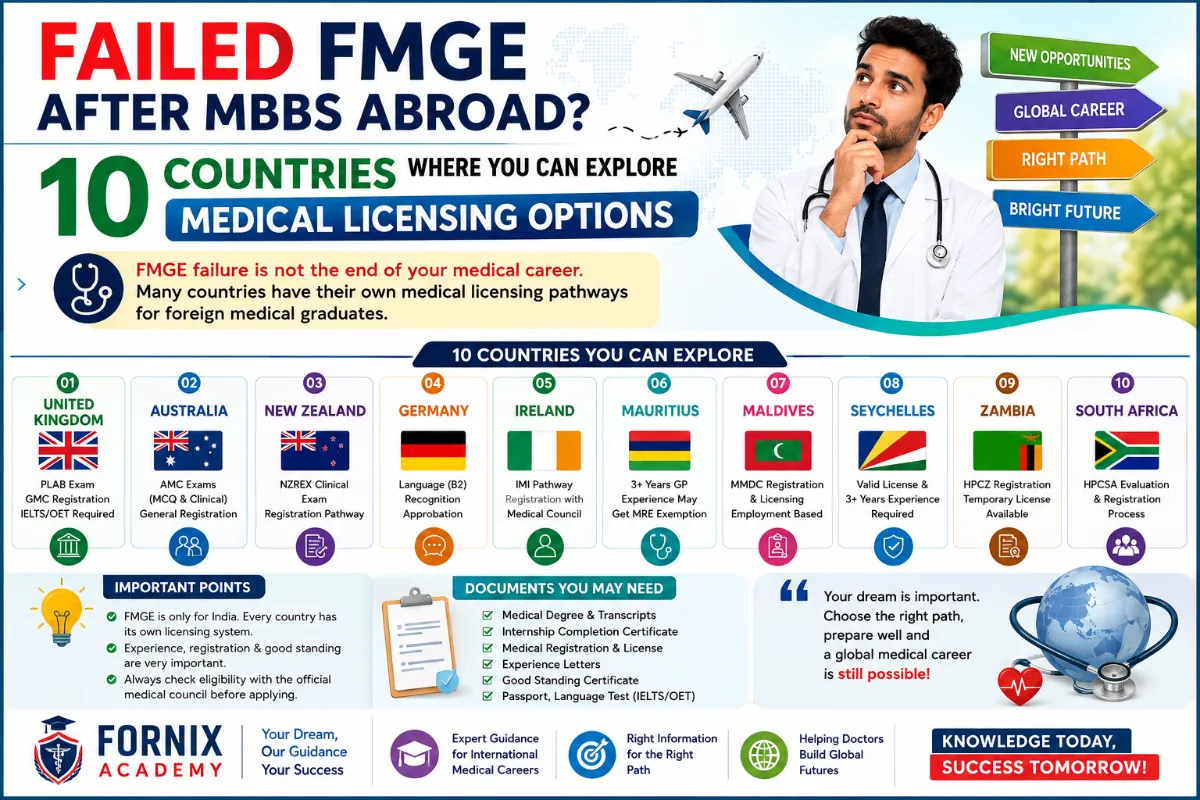
10 Countries to Explore
1. United Kingdom 🇬🇧
Pathway: GMC / PLAB pathway
The UK is one of the best-known IMG routes. The GMC assesses whether an overseas primary medical qualification is acceptable. Eligible IMGs may use the PLAB route and must meet the GMC's registration, English-language and fitness-to-practise requirements.
Important: FMGE is not the UK licensing exam. The specific overseas qualification must be acceptable to the GMC.
Official regulator / authoritative source →
2. Australia 🇦🇺
Pathway: AMC / Medical Board pathway
Australia has established assessment pathways for International Medical Graduates. The AMC Standard Pathway requires candidates to check the eligibility of their medical school, degree title and graduation year and then complete the applicable assessments before registration.
Important: FMGE failure does not automatically decide Australian eligibility; Australian requirements apply.
Official regulator / authoritative source →
3. New Zealand 🇳🇿
Pathway: NZREX / approved examination pathways
New Zealand requires doctors to be registered before practising. Depending on the applicant's circumstances, the pathway can involve NZREX Clinical or another approved registration pathway. Overseas qualifications require primary-source verification.
Important: Passing an approved exam does not automatically equal a job. NZREX candidates need a PGY1 role for registration after passing.
Official regulator / authoritative source →
4. Germany 🇩🇪
Pathway: Recognition + Approbation
Germany can be an option for foreign-trained doctors willing to complete the German recognition process. The foreign medical qualification is assessed, and language and equivalence requirements apply. An Approbation is the full licence to practise medicine.
Important: The process can involve German-language requirements and an equivalence/knowledge assessment.
Official regulator / authoritative source →
5. Ireland 🇮🇪
Pathway: Medical Council registration pathway
Doctors who wish to practise medicine in Ireland must be registered with the Medical Council of Ireland. The applicable route depends on the doctor's qualification, training, registration history and other requirements.
Important: Do not assume that an overseas medical degree alone gives the right to practise.
Official regulator / authoritative source →
6. Mauritius 🇲🇺
Pathway: Medical Council registration / GP pathway
Mauritius is particularly interesting for experienced doctors. The Medical Council states that people without a minimum of three years' GP experience have to undertake the Medical Registration Examination (MRE). Experience, registration and good-standing evidence can therefore be highly important.
Important: Three years of experience does not guarantee registration. The Council must accept the qualification, professional history and other requirements.
Official regulator / authoritative source →
7. Maldives 🇲🇻
Pathway: MMDC registration / licensing
The Maldives Medical and Dental Council regulates medical practitioners and publishes information on medical licensing examinations and registration. Foreign-trained doctors must meet the Council's applicable requirements and have their qualifications accepted.
Important: Check whether the specific medical university and qualification are recognised before relying on this pathway.
Official regulator / authoritative source →
8. Seychelles 🇸🇨
Pathway: SMDC registration
Seychelles has a formal registration process for foreign-qualified doctors. The current application information includes qualification documents and, for applicable applicants, evidence related to registration, practice and professional standing.
Important: For experienced doctors, current/previous registration and good-standing evidence can be especially important.
Official regulator / authoritative source →
9. Zambia 🇿🇲
Pathway: HPCZ registration / licensure
Zambia regulates health practitioners through the Health Professions Council of Zambia. The Council operates licensure examinations and registration processes for eligible practitioners, including foreign-trained applicants.
Important: A foreign medical degree alone is not enough; qualification verification and the Council's licensing/registration requirements apply.
Official regulator / authoritative source →
10. South Africa 🇿🇦
Pathway: HPCSA foreign-qualified pathway
South Africa has a formal process for foreign-qualified medical practitioners. The HPCSA provides guidance and documentation for foreign graduates, and overseas qualifications may need verification and assessment before registration.
Important: The process can be detailed and may include assessment or examination requirements depending on the applicant.
Official regulator / authoritative source →
Country-Wise Quick Comparison
Country | Main Regulator | Typical Route | Key Caution |
UK | GMC | PLAB / registration | Qualification must be acceptable |
Australia | AMC / Medical Board | IMG assessment pathway | School, degree & graduation year |
New Zealand | MCNZ | NZREX / approved pathway | PGY1/job requirement after NZREX |
Germany | State authorities | Recognition + Approbation | German language + equivalence |
Ireland | Medical Council | Registration route | Individual route assessment |
Mauritius | Medical Council | GP registration / MRE rules | 3+ years GP experience can matter |
Maldives | MMDC | Registration / licensing | Qualification recognition |
Seychelles | SMDC | Registration | Registration/licence & good standing |
Zambia | HPCZ | Licensure + registration | Council assessment applies |
South Africa | HPCSA | Foreign-qualified pathway | Qualification verification/assessment |
Does 3–5 Years of Experience Make a Difference?
Yes, experience can materially change the options available to an experienced doctor. Some regulators distinguish between fresh graduates and doctors with established clinical practice.
Mauritius is a particularly clear example: its Medical Council states that people without a minimum of three years' GP experience have to undertake the Medical Registration Examination. However, the Council can still require evidence of registration, practice and good standing, and the final decision remains with the regulator.
The same principle is important elsewhere: '5 years working in a hospital' is not automatically the same as '5 years of legally registered, independently authorised medical practice.' Regulators may verify registration, licence, employer records and good standing.
Documents You Should Prepare
- Primary medical qualification / degree certificate
- Academic transcripts and detailed marksheets
- Internship completion certificate
- Medical registration certificate(s), if any
- Current practising licence, if applicable
- Certificate of Good Standing
- Employment and experience certificates
- Detailed CV
- Passport and identity documents
- Primary-source verification documents where required
- English-language or local-language evidence where required
- Name-change or other supporting legal documents, if applicable
7 Questions to Ask Before Paying an Agent
- Is my exact medical university recognised by the regulator?
- Is my exact degree title accepted?
- Is my graduation year eligible?
- Is my internship accepted?
- Does my clinical experience count as recognised medical practice?
- Do I need a licensing examination or supervised practice?
- Can the regulator confirm my eligibility in writing before I pay an agency?
Best Way to Think About FMGE Failure
FMGE failure should not be treated as a blanket statement that an Indian medical graduate can never practise medicine again. At the same time, it is unsafe to claim that an FMGE-failed graduate can simply move abroad and start working as a doctor.
The correct approach is to identify a legitimate country-specific licensing pathway, verify the qualification and professional history, complete every required assessment, obtain registration, and only then practise within the scope authorised by the regulator.
FAQ Section
Q: Can I work abroad after failing FMGE?
A: Possibly. FMGE failure does not itself determine eligibility in another country. You must satisfy that country's medical licensing and registration requirements.
Q: Does FMGE failure cancel my foreign medical degree?
A: No. Whether a foreign medical qualification is accepted for practice is determined by the regulator in the destination country.
Q: Can a Georgia MBBS graduate work in the UK after failing FMGE?
A: Potentially, if the specific primary medical qualification is acceptable to the GMC and the graduate meets the GMC's PLAB/registration and other requirements.
Q: Does 3 years of GP experience help?
A: It can. Mauritius, for example, explicitly uses a three-year GP experience threshold in its Medical Registration Examination rules.
Q: Can I work in Mauritius after failing FMGE?
A: Potentially, subject to Medical Council of Mauritius requirements, qualification recognition, registration, experience and any applicable examination requirements.
Q: Can I work in Maldives after failing FMGE?
A: Potentially, subject to MMDC qualification recognition and the applicable licensing/registration process.
Q: Can I work in Seychelles with foreign MBBS?
A: Potentially, but the Seychelles Medical and Dental Council has specific registration criteria, including documentation relating to qualifications and professional status.
Q: Should I trust an agent who guarantees a doctor licence?
A: No. Always verify the pathway directly with the country's medical regulator before paying an agent or accepting a job.
Written by: Venkat
Fornix Academy
Contact
🌐 Website: www.fornixacademy.com
📞 Call: +91 90304 48482
📧 Email: venkat@fornixacademy.com
📱 Instagram: @fornix.academy