Candidate Count • PG Seats • Clinical Branch Competition • Counselling Strategy
IMPORTANT DATA NOTE 2,73,183 is the reported registration figure. The Government's 86,360 figure is the broader postgraduate medical-seat count and should not be presented as 86,360 MD/MS-only seats. For MD/MS/broad-specialty counselling, use the applicable NMC seat matrix. |
Introduction
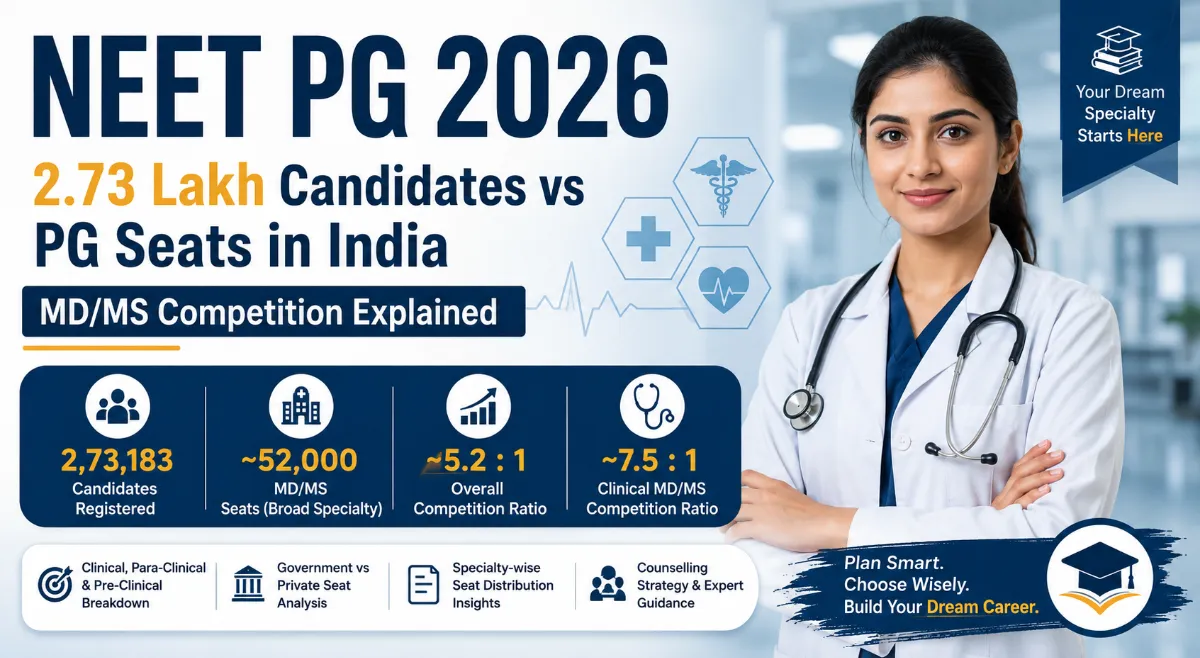
NEET PG 2026 is one of India's largest postgraduate medical entrance examinations. A total of 2,73,183 candidates successfully registered for the 2026 examination. The examination is being conducted on 30 August 2026 in a single shift across approximately 340 cities and more than 1,300 examination centres.
For medical graduates, however, the candidate count is only one part of the competition equation. The more important questions are how many postgraduate medical seats are available, how those seats are distributed across different programmes, and how competition changes according to specialty, institution, quota and category. For the latest official candidate information, see the PIB NEET PG 2026 candidate statistics.
This article explains the NEET PG 2026 competition using the latest available candidate and seat information and separates the broader national PG-seat figure from the MD/MS-focused competition. "Neet PG 2026 Results"
NEET PG 2026 at a Glance
Particular | NEET PG 2026 |
Candidates registered | 2,73,183 |
Exam date | 30 August 2026 |
Exam timing | 9:00 AM – 12:30 PM |
Exam mode | Computer-based |
Questions | 180 |
Maximum marks | 720 |
Duration | 210 minutes |
Examination cities | ~340 |
Examination centres | 1,300+ |
How Many Candidates Registered for NEET PG 2026?
A total of 2,73,183 candidates successfully registered for NEET PG 2026. The Government has reported that registrations increased by more than 12.5% compared with the previous year.
The official NEET PG 2026 registration and examination-centre information should be used when quoting the candidate figure in articles, social media posts and counselling content.
It is important to distinguish registered candidates from candidates who actually appeared. Registration is confirmed before the exam, while final attendance should be reported only after an official attendance figure is released.
KEY NUMBER |
How Many PG Medical Seats Are Available in India?
India's postgraduate medical education capacity has expanded substantially. The Government has stated that the country has 86,360 postgraduate medical seats, compared with 31,185 before 2014.
For the national figure, refer to the official Government update on PG medical seat expansion.
The 86,360 figure is a broader postgraduate medical-seat count. It should not automatically be described as 86,360 MD/MS seats because the postgraduate ecosystem includes multiple pathways and datasets.
For branch-level and broad-specialty analysis, candidates should consult the NMC College & Course Search and PG seat-matrix resources.
Why Different Websites Show Different PG Seat Numbers
Candidates may see different numbers for 'PG seats in India' because sources may count different categories. A broad national figure can represent postgraduate medical capacity across multiple pathways, whereas an MD/MS-focused analysis may use the NMC PG Broad Specialty Seat Matrix.
This distinction matters for SEO as well as accuracy. A page that says '86,360 MD/MS seats' can create a misleading impression. The article should clearly define whether it is discussing the broader PG ecosystem or a particular MD/MS/broad-specialty seat matrix.
When publishing your own counselling content, link the phrase official NMC PG Broad Specialty Seat Matrix to the NMC source rather than relying only on third-party seat aggregators.
2.73 Lakh Candidates vs PG Seats: What Does the Ratio Mean?
Using 2,73,183 registrations and the broader national figure of 86,360 postgraduate medical seats gives approximately 3.16 registered candidates per broader PG seat.
Calculation: 2,73,183 ÷ 86,360 ≈ 3.16.
This is a national mathematical comparison, not a 1-in-3 admission probability. Candidates do not compete for every seat equally. Eligibility, specialty preference, quota, category, institution type, fees and counselling rules all affect the effective competition. "Neet PG Results"
For MD/MS-focused analysis, use the applicable NMC broad-specialty matrix rather than applying the broader 86,360 figure to every MD/MS discussion.
MD/MS Competition Is Not the Same for Every Branch
The biggest reason a national candidate-to-seat ratio can be misleading is that postgraduate branches do not have equal demand.
A candidate seeking MD Radiodiagnosis at a highly preferred government institution is competing for a very different set of seats from a candidate who is open to several clinical and non-clinical branches across multiple institution types.
Popular clinical specialties can remain highly competitive even when their total seat numbers increase.
Clinical vs Non-Clinical PG Seats
Clinical Specialties
Clinical branches involve substantial direct patient care. Common examples include MD General Medicine, MD Paediatrics, MD Radiodiagnosis, MD Dermatology, MD Anaesthesiology, MD Psychiatry, MD Respiratory Medicine, MS General Surgery, MS Orthopaedics, MS Obstetrics & Gynaecology, MS Ophthalmology and MS ENT.
These specialties attract strong demand, but competition varies significantly by specialty, college, category, quota and counselling round.
Candidates preparing for future NEET PG cycles can strengthen clinical reasoning with the Fornix Academy NEET PG Question Bank, which can be used alongside structured revision and mock-test practice.
Para-Clinical Specialties
Para-clinical disciplines include MD Pathology, MD Microbiology, MD Pharmacology, MD Forensic Medicine and MD Community Medicine. These fields can offer career pathways in diagnostics, academics, public health, research, pharmaceutical medicine and laboratory-based practice.
Pre-Clinical Specialties
Pre-clinical disciplines primarily include MD Anatomy, MD Physiology and MD Biochemistry. They are important areas for medical education, biomedical research and academic careers. Candidates should evaluate these branches according to long-term goals rather than treating them simply as lower-competition options.
Branch-Wise Seat Numbers: How to Read Them
Seat numbers change as colleges receive new approvals, seats are increased or withdrawn, and counselling authorities publish updated matrices. Therefore, historical or third-party specialty totals should be treated as reference data rather than a guarantee for the 2026 counselling cycle.
The most reliable place to verify applicable college and course information is the National Medical Commission's College & Course Search.
For a counselling article, use a clear note such as: 'Approximate figures are based on the referenced seat matrix and should be verified against the final counselling-year matrix before choice filling. "Neet PG counselling Dates"
Government vs Private PG Seats
The total number of PG seats does not represent the number of seats every candidate is willing or able to consider.
- Government medical colleges
- Low-fee institutions
- A particular state
- One or two preferred specialties
- Specific quota or category
- Private or deemed universities
A candidate who restricts choices to government colleges and a small number of popular clinical branches is competing within a much smaller effective pool. Candidates considering private or deemed universities must also evaluate tuition fees, service bonds, hostel costs and institutional rules.
Therefore, 'Can I get a PG seat?' and 'Can I get the branch and college I want?' are two different counselling questions.
All India Quota vs State Quota
Postgraduate counselling is divided across national and state-level processes, subject to the applicable rules for the relevant institution and seat category. Candidates should not assume that every seat follows the same quota or domicile framework.
For national counselling notifications and schedules, candidates should follow the Medical Counselling Committee (MCC) and the relevant state counselling authority.
Reservation, domicile, service obligations, eligibility and seat distribution can vary. Always verify the current counselling notice before filling choices.
Why Rank Matters More Than the Overall Selection Ratio
Consider two candidates from the same national pool. Candidate A may target MD Radiodiagnosis in a government institution and have a narrow list of acceptable colleges. Candidate B may accept several clinical specialties across multiple states and institution types. Their counselling possibilities can be completely different even if their national ranks are similar.
THE PRACTICAL QUESTION |
NEET PG 2026 Exam Pattern
NEET PG 2026 has a revised examination structure with 180 questions and 210 minutes of total examination time. The paper carries 720 maximum marks.
- 180 questions
- 720 maximum marks
- +4 for a correct answer and -1 for an incorrect answer
- 5 time-locked sections
- 36 questions per section
- 42 minutes per section
- 210 minutes total
The examination is divided into five mandatory time-locked sections of 36 questions each, with 42 minutes allocated to each section. Once a section closes, candidates cannot return to it. This makes sectional pacing and decision-making important.
What Happens After NEET PG 2026?
Step 1: NEET PG examination
Step 2: Result and rank
Step 3: Counselling registration
Step 4: Choice filling
Step 5: Seat allotment
Step 6: Reporting and admission
For national-level counselling, candidates should monitor official MCC counselling updates and applicable NBEMS/NMC notices. State counselling authorities publish their own schedules and seat matrices.
What Candidates Should Analyse After the Exam
- Overall difficulty level
- Clinical application and integrated questions
- Subject-wise distribution
- Image-based questions
- Recall versus reasoning
- Expected score range
- Expected rank
Expected scores and ranks published by coaching platforms are estimates until official results are released. Candidates should compare multiple credible analyses rather than relying on one unofficial prediction.
Strategic Choice-Filling Checklist
- Branch preference
- Previous closing trends
- College and institution type
- Quota and category
- Tuition fees and other costs
- Service bonds and obligations
- Location
- Patient load and clinical exposure
- Academic environment
- Long-term career goals
A broad preference list can provide more counselling opportunities than a narrow list containing only a few highly competitive combinations. However, candidates should never include a branch or institution they would genuinely refuse to join simply to increase the number of choices.
NEET PG 2026: The Real Competition Equation
The 2,73,183 registrations show the size of the candidate pool. The Government's 86,360 figure shows the scale of India's broader postgraduate medical capacity. The NMC broad-specialty seat matrix provides the more relevant framework when analysing MD/MS/broad-specialty seats.
REAL COUNSELLING EQUATION |
Candidates should focus on their individual rank and build a strategic, realistic choice list rather than relying only on an overall candidate-to-seat ratio.
Frequently Asked Questions
How many candidates registered for NEET PG 2026?
A total of 2,73,183 candidates successfully registered for NEET PG 2026.
How many candidates actually appeared for NEET PG 2026?
The confirmed pre-exam figure is 2,73,183 registrations. The final attendance number should be reported only after official confirmation.
How many PG medical seats are available in India?
The Government has stated that India has 86,360 postgraduate medical seats. This is a broader PG-seat figure and should not be described as 86,360 MD/MS-only seats.
Is 86,360 the number of MD/MS seats?
No. It is a broader postgraduate medical-seat figure. For MD/MS/broad-specialty analysis, candidates should use the latest applicable NMC PG Broad Specialty Seat Matrix.
What is the candidate-to-seat ratio using 86,360 seats?
Using 2,73,183 registrations and 86,360 broader PG seats gives approximately 3.16 registered candidates per broader PG seat. This is not an individual probability of admission.
Which NEET PG branches are most competitive?
Competition varies by year, rank, category, institution and quota. High-demand clinical branches commonly include Radiodiagnosis, Dermatology, General Medicine, Paediatrics, Orthopaedics, General Surgery and Obstetrics & Gynaecology.
Does a lower rank mean a candidate cannot get a PG seat?
Not necessarily. Seat availability changes by specialty, institution, quota, category and counselling round. Candidates should assess the actual seat matrix and closing trends.
Prepare Smarter with Fornix Academy
For doctors preparing for NEET PG, structured question practice, clinical reasoning and performance analysis can make preparation more targeted. Explore the Fornix Academy NEET PG Question Bank for subject-wise and system-wise practice, high-yield clinical questions, detailed explanations, mock tests and performance-focused preparation.
Visit Fornix Academy for medical exam preparation resources and updates.
Contact
🌐 Website: www.fornixacademy.com
📞 Call: +91 90304 48482
📧 Email: venkat@fornixacademy.com
📱 Instagram: @fornix.academy