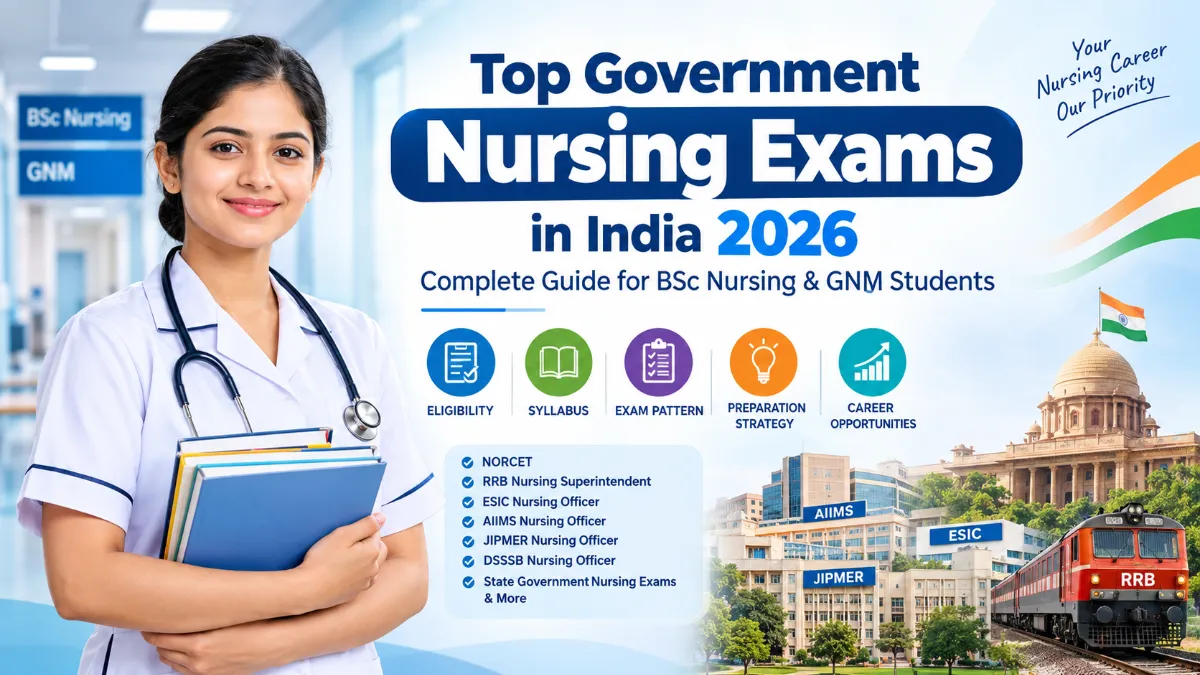

Preparing for the AIIMS Nursing Officer Recruitment Common Eligibility Test (NORCET) requires more than reading textbooks. With strong competition and a syllabus covering multiple nursing subjects, aspirants need a structured study plan, regular practice, and consistent revision. "AIIMS NORCET 2026 official notification"
Whether you are a B.Sc. Nursing, Post Basic B.Sc. Nursing, or GNM student, the right NORCET 2026 preparation strategy can help you improve accuracy, speed, and confidence. This complete guide explains the best study tips for NORCET 2026 and shows you how to prepare effectively from the beginning. "Latest NORCET syllabus and exam pattern"
## Understand the NORCET Syllabus and Exam Pattern
Before starting your preparation, carefully review the latest NORCET notification, syllabus, eligibility requirements, and examination pattern issued by AIIMS. Exam details, marking schemes, stages, and other instructions may change, so always rely on the official notification for final information.
The NORCET syllabus generally focuses heavily on nursing subjects, along with relevant non-nursing areas in the preliminary stage. Major subjects include:
- Fundamentals of Nursing
- Medical-Surgical Nursing
- Pharmacology
- Obstetric and Gynecological Nursing
- Child Health Nursing
- Community Health Nursing
- Mental Health Nursing
- Anatomy and Physiology
- Nutrition and Dietetics
- Nursing Research and Statistics
- General Knowledge, Aptitude, and Reasoning
Clinical subjects such as Medical-Surgical Nursing, Community Health Nursing, Obstetric Nursing, and Pediatrics should receive special attention because they form an important part of nursing entrance preparation. nprep
## Create a Realistic Daily Study Plan
A good timetable should be practical rather than exhausting. Studying for long hours without concentration may lead to burnout, so divide your day into focused study blocks.
A sample NORCET 2026 daily timetable may look like this:
- **2 hours:** Core nursing theory
- **1.5 hours:** Medical-Surgical Nursing or another major subject
- **1 hour:** Topic-wise MCQs
- **1 hour:** Revision of previously studied topics
- **30 minutes:** Pharmacology, lab values, emergency drugs, or important facts
- **30 minutes:** Mistake analysis and short-note revision
If you are a beginner, start with four to six productive hours daily and gradually increase your study time. Some preparation plans recommend combining several hours of theory with 50–70 topic-based MCQs and weekly revision. Consistency is more important than studying for 12 hours on one day and taking a long break afterward. utkarsh
## Focus on High-Priority Nursing Subjects
Do not give equal time to every chapter. Begin with subjects that build your nursing foundation and frequently connect with clinical scenarios.
### Medical-Surgical Nursing
Study each system systematically, including anatomy, physiology, diseases, signs and symptoms, investigations, treatment, complications, and nursing management. Give additional attention to cardiovascular, respiratory, neurological, renal, gastrointestinal, and endocrine disorders.
### Fundamentals of Nursing
Revise nursing procedures, infection control, vital signs, patient safety, positioning, documentation, the nursing process, therapeutic communication, and emergency care.
### Obstetric and Gynecological Nursing
Focus on antenatal care, stages of labour, complications of pregnancy, postpartum care, newborn assessment, family planning, and obstetric emergencies.
### Community Health Nursing
Study national health programmes, epidemiology, primary healthcare, immunisation, health education, environmental sanitation, maternal and child health, and community nursing practices.
### Pharmacology and Pediatrics
Revise drug classifications, indications, adverse effects, antidotes, contraindications, dosage calculations, and commonly used emergency medicines. In Pediatrics, concentrate on growth and development, childhood diseases, immunisation, neonatal care, and fluid management.
## Use One Reliable Source and Short Notes
Collecting too many books, PDFs, videos, and question banks can create confusion. Select one reliable primary resource for each subject and use additional material only when you need clarification.
Make short, revision-friendly notes instead of rewriting entire chapters. Useful notes may include:
- Drug names, actions, and antidotes
- Normal laboratory values
- Important definitions
- Emergency protocols
- Immunisation schedules
- Disease-wise nursing interventions
- Formulas and frequently confused concepts
Your notes should be concise enough to revise quickly during the final weeks.
## Practise MCQs Every Day
Reading theory alone is not enough to succeed in NORCET. Solve MCQs after completing each topic to test your understanding and identify weak areas.
Start with 40–50 questions daily and gradually increase the number. After solving a question set, review:
- Questions answered incorrectly
- Questions answered through guessing
- Concepts you could not recall
- Time taken to complete the set
- Similar topics that caused confusion
Maintain a mistake notebook. Write the correct answer along with a brief explanation of why your answer was wrong. This simple habit can prevent repeated mistakes and make revision more targeted.
Previous year papers help you understand the difficulty level, question style, important concepts, and recurring topics. Try solving them under timed conditions rather than reading only the answers.
Once your syllabus is substantially complete, include sectional and full-length mock tests in your routine. A preparation plan may include one or two sectional tests weekly during the early phase and two to three full-length mocks per week closer to the examination. [utkarsh] (https://utkarsh.com/exams/norcet/norcet-preparation-tips/aiims-norcet-preparation-strategy-6-month-study-plan)
Mock tests are valuable only when you analyse them properly. Spend time reviewing every incorrect and doubtful question. A useful approach is to spend approximately 20% of your practice time attempting tests and 80% reviewing errors, revising weak concepts, and improving strategy.
## Follow a Smart Revision Cycle
Revision should begin from the first day of preparation. Use a simple cycle:
1. Revise the topic on the same day.
2. Revise it again after seven days.
3. Test yourself after three weeks.
4. Revisit it during your final revision.
Active recall is more effective than repeatedly reading the same page. Close your book and try to remember key points, explain a concept aloud, draw a flowchart, or solve questions without looking at the answer.
## Improve Accuracy and Time Management
NORCET preparation is not only about knowing the answer; it is also about selecting the correct option under time pressure. Practise eliminating clearly incorrect options and avoid blind guessing, especially when negative marking applies according to the applicable exam pattern.
During mock tests, develop a question-attempting strategy. Answer straightforward questions first, mark doubtful questions for review, and avoid spending too much time on one difficult item. Aim to improve accuracy before increasing your attempts.
## Avoid Common Preparation Mistakes
Many candidates lose valuable preparation time because they:
- Change study resources repeatedly
- Ignore weak subjects
- Delay mock-test practice
- Memorise without understanding clinical concepts
- Skip revision
- Study without tracking progress
- Compare their timetable with other aspirants
Instead, follow a flexible plan, measure your weekly performance, and make changes based on your mock-test analysis.
The best way to prepare for AIIMS NORCET 2026 is to combine strong concepts, daily MCQ practice, previous year papers, regular revision, and mock-test analysis. Give priority to core nursing subjects, maintain a mistake notebook, and keep your study plan realistic.
Most importantly, check the official AIIMS website regularly for the latest notification, dates, syllabus updates, and examination instructions. With disciplined preparation and consistent practice, you can approach NORCET 2026 with greater confidence and improve your chances of securing a Nursing Officer position. "how to apply for norcet exam"
Written by: Venkat
Contact
🌐 Website: www.fornixacademy.com
📞 Call: +91 90304 48482
📧 Email: venkat@fornixacademy.com
📱 Instagram: @fornix.academy