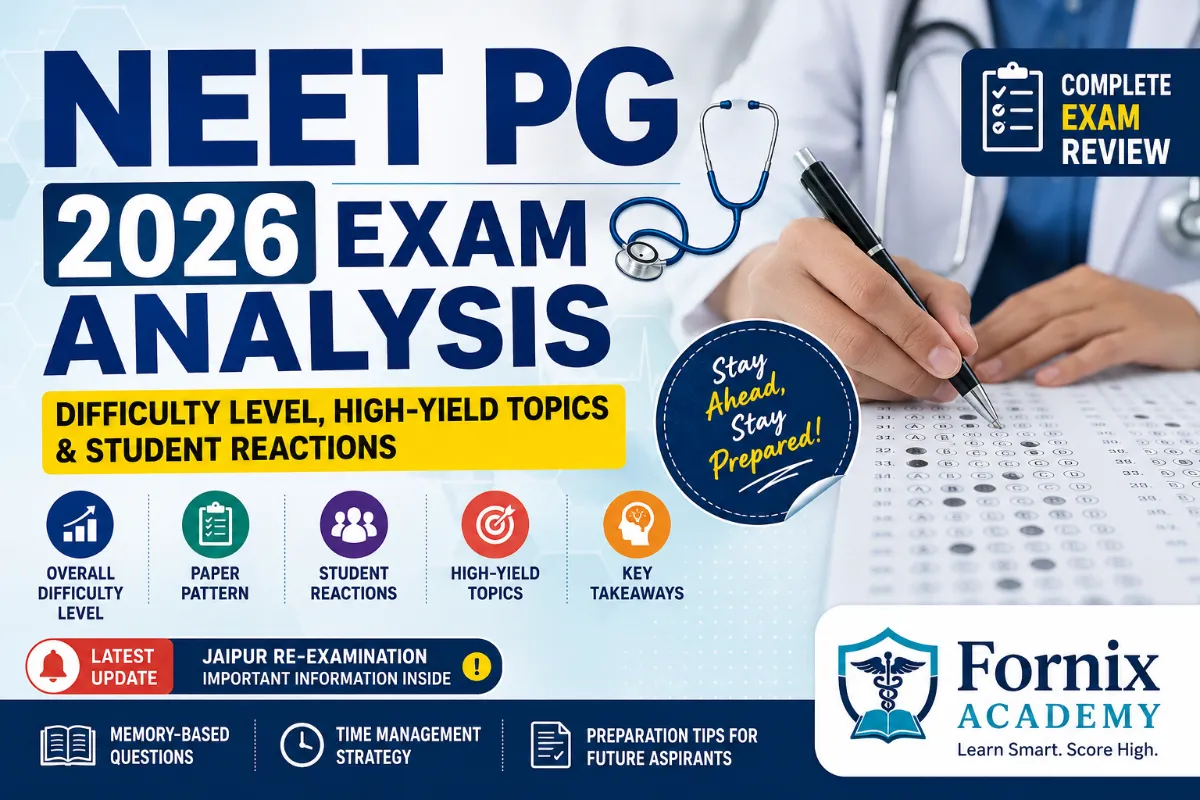
NEET PG 2026 Exam Analysis:
Difficulty Level, High-Yield Topics & Student Reactions
publication draft • Updated 31 August 2026
EDITORIAL / ACCURACY NOTE |
NEET PG 2026 Exam Analysis: Quick Overview
NEET PG 2026 was conducted on 30 August 2026 in a single shift. Early candidate feedback and expert analysis described the paper as moderate to difficult overall, with many candidates calling it moderate. The paper was reported to be practical, clinical and application-oriented, with lengthy clinical scenarios and closely related answer choices making time management important.
Exam Parameter | NEET PG 2026 |
Exam date | 30 August 2026 |
Exam mode | Computer-based test (CBT) |
Registered candidates | 2,73,096 |
Candidates appeared | 2,65,980 |
Centres | 1,111 |
Cities | 339 |
Total questions | 180 |
Total marks | 720 |
Sections | 5 |
Questions per section | 36 |
Time per section | 42 minutes |
Correct answer | +4 marks |
Incorrect answer | -1 mark |
Overall early assessment | Moderate to difficult |
NEET PG 2026 Difficulty Level
The most defensible early assessment is moderate to difficult, with most available candidate feedback leaning toward moderate. The paper was not uniformly difficult: candidates encountered easy, moderate and difficult questions. What made the examination challenging for many was the combination of clinical application, lengthy scenarios, similar answer options and fixed sectional timing.
The exam therefore rewarded candidates who could apply medical concepts to clinical situations rather than relying only on direct factual recall.
Why Did NEET PG 2026 Feel Difficult?
- Clinical and practical application was prominent in candidate feedback.
- Some questions involved lengthy clinical scenarios that required careful reading.
- Some answer choices were closely related, making option elimination important.
- The fixed 42-minute time limit for each section made pacing critical.
- The reduction to 180 questions did not automatically make the examination easier because individual clinical questions could take longer to interpret.
NEET PG 2026 Paper Pattern
NEET PG 2026 had 180 questions carrying 720 marks. The paper was divided into five sections, with 36 questions in each section and 42 minutes allotted to each section. The examination lasted 3 hours 30 minutes.
For official examination information, candidates should use the NBEMS official website rather than relying on social-media posts or unofficial summaries.
NEET PG 2026 Student Reactions
Moderate overall: Several candidates described the paper as moderate, while others considered it moderate to difficult or tougher than expected.
Practical and clinical: Candidates reported that many questions required application of clinical concepts rather than simple recall.
Lengthy and time-sensitive: Long clinical scenarios and the fixed sectional clock made time management a recurring concern.
Closely related options: Some candidates found it difficult to distinguish between similar answer choices.
PYQs remained relevant: Candidate discussions indicated that previous-year concepts remained useful, although the examination also required application and interpretation.
For independent reporting on NEET PG 2026 student reactions and difficulty level, see the linked analysis.
What Type of Questions Were Asked in NEET PG 2026?
Clinical case-based questions
Questions built around symptoms, signs, investigations, diagnosis or management decisions.
Application-based questions
Questions that required candidates to apply a known concept to a clinical situation.
Conceptual questions
Questions testing mechanisms and understanding rather than simple one-line recall.
Investigation-based questions
Questions requiring interpretation of laboratory, imaging or other clinical information.
Image-based questions
Very few image-based questions were reported by candidate/expert feedback; an exact official count should not be claimed.
Video-based questions
Candidate reports indicated that no video-based questions were asked.
NEET PG 2026 High-Yield Topics
NBEMS does not provide an official public subject-wise question-count table for the paper. Therefore, exact claims such as 'X questions from Medicine' or 'Y% image-based questions' should not be presented as official facts. For revision, however, the following high-yield areas remain clinically important and align with the application-oriented nature reported by candidates.
General Medicine
- Cardiology and ECGs
- Neurology
- Infectious diseases
- Endocrinology
- Nephrology
- Respiratory medicine
- Gastroenterology
- Hematology
- Emergency and critical care
General Surgery
- Trauma and acute abdomen
- GI surgery
- Breast and thyroid
- Hernia
- Colorectal disease
- Surgical oncology
- Perioperative management
- Surgical anatomy
Obstetrics & Gynaecology
- Obstetric emergencies
- Labour and fetal monitoring
- Hypertensive disorders of pregnancy
- High-risk pregnancy
- Contraception
- Gynaecological malignancies
- Menstrual disorders and infertility
Pathology
- General pathology
- Neoplasia
- Hematology
- Histopathology
- Systemic pathology
- Tumour markers
- Molecular pathology
Pharmacology
- Mechanisms of action
- Adverse drug reactions
- Drug interactions
- Antimicrobials
- CNS and cardiovascular drugs
- Endocrine drugs
- Emergency drugs
Microbiology
- Bacteriology
- Virology
- Parasitology
- Mycology
- Immunology
- Opportunistic infections
- Diagnostic microbiology
- Antimicrobial resistance
Community Medicine / PSM
- Epidemiology
- Biostatistics
- Screening
- National health programmes
- Vaccination
- Health indicators
- Study designs
NEET PG 2026 Memory-Based Questions and Recalls
After the examination, candidates and educators may reconstruct questions from memory. These NEET PG 2026 memory-based questions can help identify tested concepts, but they should not be treated as the official question paper. Exact wording, options and details may differ from what appeared in the examination.
BEST WAY TO USE RECALL QUESTIONS |
Should You Still Study PYQs for NEET PG?
Yes. Previous-year questions remain an important part of NEET PG preparation, but PYQ revision should be concept-based. Instead of memorising only the correct option, ask:
- Why is the correct option correct?
- Why are the other options wrong?
- What underlying concept is being tested?
- How could the same concept appear in a different clinical case?
- Which related high-yield topics should be revised?
What Should Future NEET PG Aspirants Do?
Strengthen core concepts: Build a strong foundation before depending entirely on rapid revision.
Practise clinical MCQs: Include case-based, image-based and application-oriented questions in regular practice.
Practise timed sections: Use 42-minute blocks to reproduce the pressure of the revised sectional format.
Analyse mistakes: Track wrong answers, guessed answers, slow questions and recurring conceptual errors.
Revise repeatedly: Repeated active revision is more useful than continuously collecting new resources.
Integrate subjects: Connect anatomy, pathology, pharmacology, microbiology and clinical medicine around the patient presentation.
NEET PG 2026 Jaipur Re-Examination: Latest Update
The Ministry of Health and Family Welfare reported that NEET PG 2026 was successfully conducted for the overwhelming majority of candidates nationwide. However, the examination could not be completed for 2,445 candidates at two iON Digital Zone Sitapura centres in Jaipur because of an internal power-supply disruption.
The official PIB release states that the affected candidates will take the re-examination on Saturday, 5 September 2026, at 3:00 PM in Jaipur. Venue details and other instructions are to be communicated separately.
IMPORTANT |
For verification of viral claims, candidates can consult PIB Fact Check and official NBEMS communications.
NEET PG 2026 Exam Analysis: What We Learned
- Clinical reasoning is increasingly important.
- Integrated preparation helps when a question crosses subject boundaries.
- Understanding PYQs is more valuable than memorising their exact wording.
- Timed practice matters because each section has a fixed clock.
- High-yield revision should be repeated and actively tested.
NEET PG Preparation With Fornix Academy
Fornix Academy provides NEET PG preparation resources for medical aspirants. Use the relevant internal Fornix pages for NEET PG MCQs, PYQs, mock tests and high-yield revision once those pages are published on the website.
Explore Fornix Academy for medical exam preparation resources.
Frequently Asked Questions
When was NEET PG 2026 conducted?
NEET PG 2026 was conducted on 30 August 2026 in a single shift.
How many questions were asked in NEET PG 2026?
The examination had 180 questions carrying 720 marks.
What was the difficulty level of NEET PG 2026?
Initial candidate and expert feedback described the paper as moderate to difficult overall, with many candidates rating it moderate.
How many sections were there in NEET PG 2026?
There were five sections, with 36 questions and 42 minutes per section.
Was NEET PG 2026 clinical and application-based?
Initial candidate feedback indicated a strong practical and clinical application focus.
Were image-based questions asked?
Candidate/expert reports indicated very few image-based questions. An exact official count should not be claimed unless independently verified.
Was there a Jaipur re-examination?
Yes. According to the Ministry of Health and Family Welfare, 2,445 candidates affected by the technical disruption at two Jaipur centres are scheduled to reappear on 5 September 2026 at 3 PM.
Are memory-based recalls the official question paper?
No. Memory-based recalls are reconstructed from candidate memory and may differ from the original examination wording and options.
Final Takeaway
NEET PG 2026 PREPARATION LESSON |
Concepts + PYQs + Clinical MCQs + High-Yield Revision + Timed Practice
Study the concept, not just the answer.
Contact
🌐 Website: www.fornixacademy.com
📞 Call: +91 90304 48482
📧 Email: venkat@fornixacademy.com
📱 Instagram: @fornix.academy